
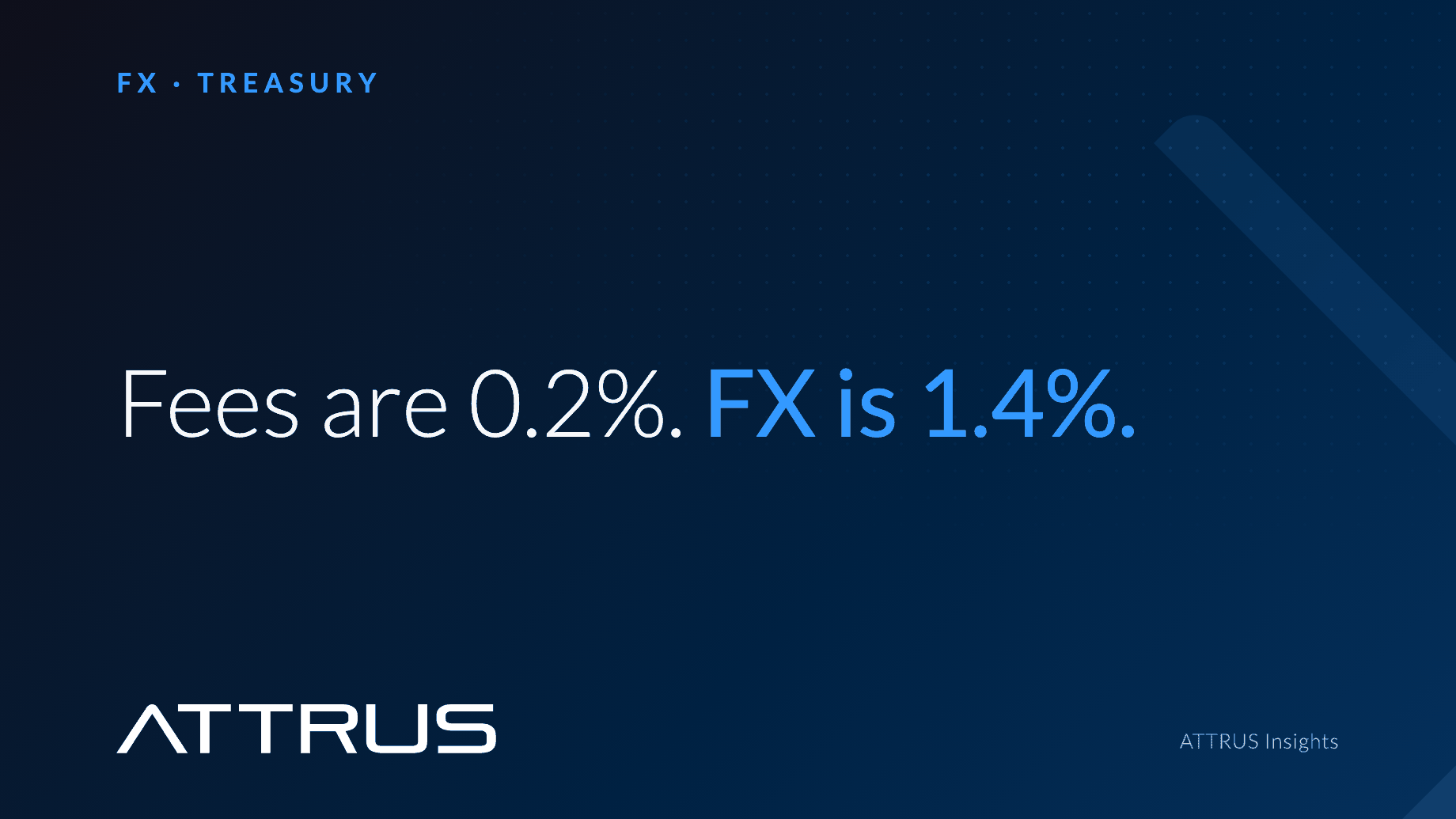
Intelligent payment orchestration is the decision layer that chooses how a cross-border payment executes: route, currency leg, liquidity, rail and timing, evaluated per transaction before the money moves. It belongs to treasury because of where the cost sits: the currency leg carries 87.1% of the average cost of a business-to-business cross-border payment, against 0.2 percentage points in fees (Financial Stability Board, October 2025).
Most teams evaluating orchestration are evaluating integrations: one API instead of five, one contract instead of five. That is a real benefit, and it is the smaller half of the problem. The larger half is the set of choices made about each payment before it executes. Which currency leg, priced at which moment, drawing on which balance, over which rail. Those choices happen thousands of times a month, they are measurable, and in the aggregate data they account for almost the entire cost of moving money across a border.
What is intelligent payment orchestration?
It is a decision layer between a payment instruction and the rails that execute it, and its job is to choose the execution. A definition that holds on its own: orchestration is intelligent when the client defines the outcome, meaning amount, destination currency and deadline, and the infrastructure selects the path, instead of the client selecting a provider per corridor and inheriting whatever that provider does next.
Two properties separate that from a router. The decision is evaluated per transaction rather than configured once per corridor, and it covers the currency conversion and the balance the payment draws on, not only the choice of provider. A layer that picks a provider and inherits everything after that is doing a narrower job, and the cost data below shows how much narrower.
87.1% of a B2B payment's cost is the currency leg
The average business-to-business cross-border payment cost 1.6% of the amount sent in March 2025. Of that, 1.4 percentage points were the foreign exchange margin and 0.2 were fees, which puts the FX component at 87.1% of the total (FXC Intelligence, March 2025, via the FSB). For person-to-business payments the same table reports 99.7%.
That ratio is why orchestration belongs to treasury rather than to engineering. Renegotiating the fee line addresses the 0.2. The other 1.4 is decided by when the conversion happens, which currency pair it goes through, and whether the payment has to travel through a third currency to reach its destination. A provider who quotes a fee and stays quiet about the conversion has priced the visible tenth of the bill.
The G20 target for this segment, set out in the FSB's Targets for Addressing the Four Challenges of Cross-Border Payments, is a global average of no more than 1%, with no corridor above 3%, by the end of 2027 (Financial Stability Board, October 2021). In March 2025, 18.3% of corridors were still above 3% (FXC Intelligence, March 2025).
Speed stopped being the variable that moves on its own
In 2025, 35.4% of retail cross-border payment services credited funds within one hour, against a target of 75% by the end of 2027. The share settling within one business day fell to 67.3%, a decline of 6.7 percentage points since 2023 (Financial Stability Board, 2025). The FSB adds that the one-hour improvement was primarily driven by changes in sample composition.
Its assessment of the five-year programme is direct. The majority of the Roadmap actions have been completed, those efforts have not yet translated into tangible improvements for end-users at the global level, and it is unlikely that satisfactory improvements at the global level will be achieved in line with the 2027 timetable.
A decade of instant rails did not close that gap, because a rail is one leg of the path. A payment that clears in seconds domestically and then waits on a correspondent, a cut-off time or a compliance queue is not fast to the person waiting for it. The decision about which legs a payment uses moves its end-to-end speed more than the speed of any single leg.
How does an orchestration layer decide where a payment goes?
It evaluates eight things in sequence, and each one narrows the options for the next.
- Intent. What the client asked for: amount, destination currency, deadline.
- Context. What the flow already knows about this counterparty, corridor and pattern.
- Risk. Screening and monitoring on both ends, before anything is committed.
- Currency. One conversion leg, priced at the moment of Pay-In or payout.
- Liquidity. Which balance, in which currency and at which entity, the payment draws on.
- Routing. Which path meets the requested outcome at the lowest total cost today.
- Rail. The local rail that lands inside the deadline: seconds on Pix and SPEI, hours on PSE.
- Settlement. How the movement is recorded, in the currency each leg happened in.
The eighth step is the one most often missing from an orchestration pitch and the first one a controller asks about. A route whose reasoning cannot be read back a month later is a route nobody will approve twice. ATTRUS runs the sequence with one FX leg executed at the moment of Pay-In or payout, one ledger across currencies and entities, and statements, typed webhooks and audit trails on every state change.
The three cheapest services in a corridor cost half the average
Sending USD 200 as a remittance cost 6.5% globally in 2025, after 6.4% in 2024 and 6.3% in 2023. In the same corridors, at the same time, the average of the three cheapest qualifying services, which the World Bank publishes as the SmaRT average and describes as the cost faced by an informed consumer, was 3.3% (World Bank, Remittance Prices Worldwide, Q1 2025).
This is remittance data, person to person, and it is not a proxy for corporate pricing. What it measures is the distance between the available price and the paid price, in the same corridor, for the same amount, in the same quarter. The cheaper option existed. It cost roughly half. Most senders did not take it.
That distance is what a decision layer exists to close, and it does not close by renegotiating a rate card once a year. It closes by evaluating the options on each transaction. The limit of the argument is in the same table: the share of corridors where even the three cheapest services average more than 5% rose to 19.3% in 2025. In those corridors the problem is the supply of options, and no amount of selection logic invents one.
What does orchestration not solve?
Three categories, and a plan that assumes otherwise slips late.
Local authorization
The entity that holds the license in a market is the entity that can transact on that market's rails. Orchestration selects among the rails a provider can reach, and it cannot conjure reach that provider does not have. The FSB's 2025 report states the structural version plainly: the first and last mile rely on domestic rails. Which is why the useful question about a provider is which entity, registration and supervisor apply in each country, one country at a time.
Compliance friction and capital controls
Among the frictions the FSB names as persistent in 2025: misaligned anti-money laundering and counter-terrorist financing controls, privacy rules, inefficient implementation of capital controls, limited transparency for end-users, interoperability challenges and insufficient competition in certain market segments. None of those is a routing problem, and a payment held by a screening queue is not made faster by a better route.
What the receiving side charges
Sender-side cost is part of the picture. Where the receiving provider handles the conversion, the FSB's 2025 survey of 262 providers across 48 jurisdictions found additional global average FX margins of 0.7% to 1.1% on the receiving end (Financial Stability Board, 2025). The report is explicit that these cannot simply be added to sender-side costs, because the two datasets are not comparable. An orchestration layer can tell you which route it chose. Whether the beneficiary's bank takes a further margin on arrival is a question about that bank.
Four questions that separate orchestration from routing
- Where does the currency conversion happen, and when is it priced? A useful answer names the moment, such as at Pay-In or at payout, rather than quoting a spread in isolation.
- Which entity holds the license on each leg? A single answer covering three countries is not an answer.
- Can I read back why this payment took this route, a month later? If the reason is not recorded per transaction, the decision was not made per transaction.
- What share of my cost is FX margin today? The published aggregate is 87.1% for B2B. A provider who cannot produce your own number has not measured the part that dominates your bill.
The integration is what a team notices in the first month. The decision is what shows up in the twelfth, in the line of the cost report nobody could explain before.
What is intelligent payment orchestration?
A decision layer that chooses how a cross-border payment executes, per transaction, before the money moves: the route, the currency conversion and when it is priced, the balance it draws on, the local rail and how the movement is recorded. The client defines the outcome, and the infrastructure selects the path.
Where does the cost of a cross-border payment actually sit?
In the currency leg. The average business-to-business cross-border payment cost 1.6% in March 2025, of which 1.4 percentage points were the foreign exchange margin and 0.2 were fees, putting FX at 87.1% of the total (FXC Intelligence, March 2025, via the FSB). For person-to-business payments the figure is 99.7%.
How is orchestration different from a payment router or gateway?
Both select where a payment goes. The commercial difference is scope and frequency: orchestration is evaluated on every transaction rather than configured once per corridor, and it decides the currency conversion and the source of liquidity, not only which provider receives the instruction.
Are the G20 cross-border payment targets on track for 2027?
No. The G20 targets, endorsed in October 2021, set a global average retail cost of no more than 1% with no corridor above 3%, and 75% of payments credited within one hour, by the end of 2027. In 2025 the Financial Stability Board reported 35.4% credited within one hour and 18.3% of corridors above 3%, and stated that it is unlikely satisfactory improvements at the global level will be achieved in line with the 2027 timetable.
Does orchestration remove the need for a local entity?
It removes the requirement that your company be the licensed entity, not the requirement that one exists. Local accounts can be opened in your name in Brazil, Mexico and Colombia while the operating authorization stays with the provider. Orchestration then chooses among the rails that authorization reaches.